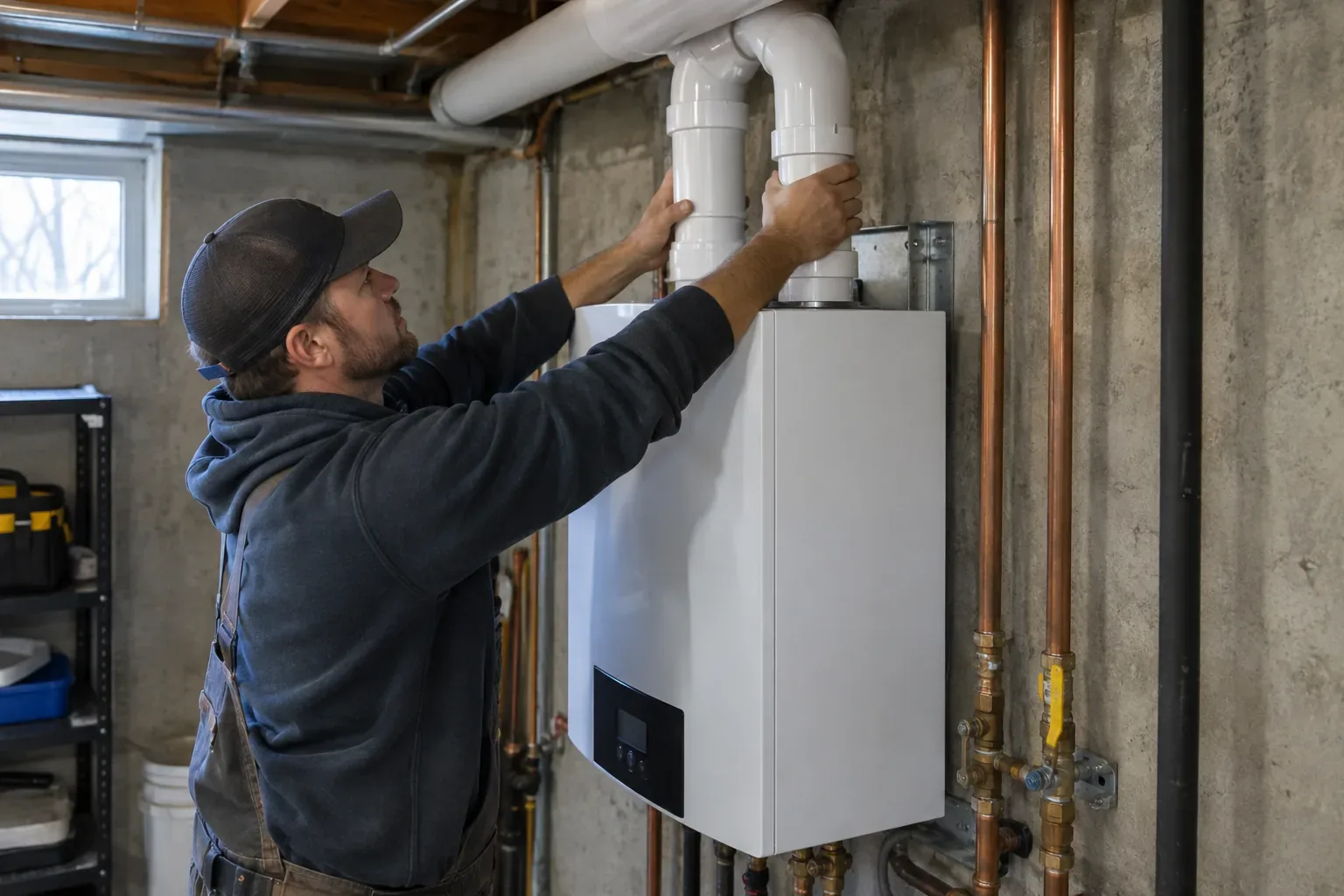
A new boiler works for its full life or fights you for it depending on choices most homeowners never see: the boiler type, the sizing, and the near-boiler piping. Prime Plumbing installs and replaces steam and hot-water boilers across Woburn and Greater Boston, sized to the house and piped correctly. Call (617) 354-4545.
A new boiler works for its full life or fights you for it depending on three decisions made before it is even mounted. A rushed installer skips them.
Cast-iron or high-efficiency
A rugged cast-iron boiler is often the sound choice for steam or an older system that runs hot. A high-efficiency condensing boiler saves fuel, but only when the distribution can run at the lower temperatures it is designed for.
Sized to the real need
Oversizing is the common mistake, and it short-cycles, wastes fuel, and wears out faster. Hot-water boilers are sized to actual heat loss; steam boilers to the connected radiator load.
Near-boiler piping done right
The few feet of piping around the boiler most determine whether it performs. On steam especially, getting it wrong produces wet steam and knocking no matter how good the unit is.
Where a proper install shows
The near‑boiler piping, and the venting
A correctly sized boiler with bad piping or wrong venting still performs poorly. Getting both right is what a proper installation means.
The near‑boiler piping is where craft shows
The piping in the few feet around the boiler most determines whether the new boiler performs, and it is the part most often done poorly. On a steam boiler especially, the manufacturer specifies how the risers and header must be piped, and getting it wrong produces wet steam, water carryover, and a boiler that knocks and heats unevenly no matter how good the unit itself is.
On a hot-water boiler, the near-boiler piping, the circulators, the primary loop, the air separation and expansion tank, determines whether the system circulates and vents correctly. We pipe the boiler to the manufacturer's specification so it runs the way it was designed to.
Risers and header piped to the manufacturer's steam specification
Circulators, primary loop, air separation, and expansion on hot water
Craft, not just connection, where a hurried install cuts a hidden corner
Venting, condensate, gas, and the permit
The venting has to match the boiler: a high-efficiency condensing boiler vents differently than the atmospheric one it replaces, and its condensate has to be handled and neutralized properly. On a gas boiler, the gas supply has to be confirmed and sometimes resized to feed the new unit, which ties in our gas piping work, done to the state code with a permit.
A boiler replacement in Massachusetts is permitted, inspected work, so the installation is checked rather than taken on trust. We handle all of it as one job.
Venting matched to a condensing or atmospheric boiler, condensate neutralized
Gas supply confirmed and resized to feed the new unit, to code
Permit pulled and inspection coordinated, not an unpermitted swap
Sizing a boiler is not the same as sizing to guesswork
Boiler sizing is where a lot of installations quietly go wrong, and the failure mode is almost always oversizing. Many of the boilers we replace were significantly larger than the house needed even when they were new, and the house has since been insulated and tightened, so the heat it needs today is lower still. An oversized boiler short-cycles, firing briefly and shutting off over and over, which wastes fuel, heats unevenly, and wears the boiler out faster, the opposite of what a bigger unit is imagined to do.
The correct approach depends on the system. A hot-water boiler is sized to the home's actual heat loss, calculated from the house as it is today, not copied from the old boiler's rating. A steam boiler is sized differently, matched to the connected radiator load it has to fill with steam, which is its own specific calculation. Either way, sizing to the real requirement rather than to the old label is what gives you even heat, lower fuel bills, and a boiler that lasts.
What to expect
What a boiler installation looks like
The right boiler, the right size, and a correct install, handled as one job.
1
We help you choose the boiler
Cast-iron or high-efficiency, matched to steam or hot water and to your distribution and budget, rather than one answer for every home.
2
We size it to the house
Hot-water boilers to actual heat loss today, steam boilers to the connected radiator load, not a copy of the oversized old unit.
3
We install it end to end
Near-boiler piping to spec, venting and condensate, gas supply confirmed, controls set, permit pulled and inspection coordinated.
From our customers
Greater Boston on Prime
Outstanding service, top-of-the-line team that installed our new boiler, kind gentlemen who answered every question we had, took their time in explaining how to use the new system. Would have them back anytime!!!
Choosing the boiler for your house and how it heats
A boiler replacement starts with choosing the right boiler for your house, and that is a real decision with trade-offs, not a default. A traditional cast-iron boiler is rugged, simpler, and long-lived, and is often the sound choice for a steam system or an older home whose distribution runs hot. A modern high-efficiency condensing boiler burns significantly less fuel, but it realizes that saving only when the system can run at the lower water temperatures it is designed for, which suits some hot-water systems and not others, and it needs specific venting and condensate handling.
The second fork is matching the boiler to how your home actually heats: a steam system needs a boiler built for steam, a hot-water system one matched to its distribution. Putting the wrong type in is how a new, expensive unit underperforms from day one. Prime Plumbing works out of 271 Salem Street in Woburn and holds Massachusetts plumbing license 17347, and does gas work to 248 CMR with the required permits. To plan a boiler replacement, contact us or call (617) 354-4545. For sizing a whole heating system beyond the boiler, see our heating system installation page.
Before you call
Common boiler installation questions.
Tell us whether you have steam or hot-water heat, your current boiler's fuel, and its age, and we can scope a replacement.
Should I get a high-efficiency condensing boiler or a cast-iron one?
It depends on your system. A high-efficiency condensing boiler burns much less fuel, but only realizes that saving when the distribution can run at the lower water temperatures it is designed for, and it needs specific venting and condensate handling. A rugged cast-iron boiler is often the sound choice for steam or an older system that runs hot. We match the boiler to how your home actually heats rather than defaulting to one answer.
Why does boiler sizing matter so much?
Because oversizing, the common mistake, makes a boiler short-cycle, firing briefly and shutting off repeatedly, which wastes fuel, heats unevenly, and wears it out faster. Many old boilers were oversized even when new, and homes have since been insulated. We size a hot-water boiler to the home's actual heat loss today and a steam boiler to the connected radiator load, rather than copying the old boiler's rating.
What is near-boiler piping and why does it matter?
It is the piping in the few feet around the boiler, and it largely determines whether the new boiler performs. On steam especially, the manufacturer specifies how it must be piped, and getting it wrong produces wet steam, knocking, and uneven heat no matter how good the boiler is. On hot water it governs circulation and air handling. It is craft, and it is where a rushed install cuts a corner you cannot see until the system misbehaves.
Can you replace a steam boiler, not just hot water?
Yes. Steam boilers need specific expertise: sizing to the connected radiator load rather than heat loss, and near-boiler piping done to the manufacturer's steam specification so the boiler produces dry steam and heats evenly. Many older Greater Boston homes run steam, and replacing one well requires someone who actually works on steam. We do, and we install steam boilers correctly for the system they serve.
Do I need a permit to replace my boiler?
Yes. A boiler replacement is permitted, inspected work in Massachusetts, and on a gas boiler the gas supply must also be confirmed and sometimes resized for the new unit. We pull the permit, install to code with correct venting and condensate handling, handle the gas, and coordinate the inspection, so the whole job is done correctly and documented rather than an unpermitted swap.
How long does a boiler last, and when should I plan to replace it?
A well-built boiler can run for decades, so replacement is rarely automatic. Plan for it when the boiler's core fails in a way that cannot be repaired, a cracked heat exchanger or leaking cast-iron sections, or when a boiler is so old, inefficient, and unreliable that repairing it keeps costing more. Assessing an aging boiler before the season lets you replace it as a planned decision rather than an emergency.